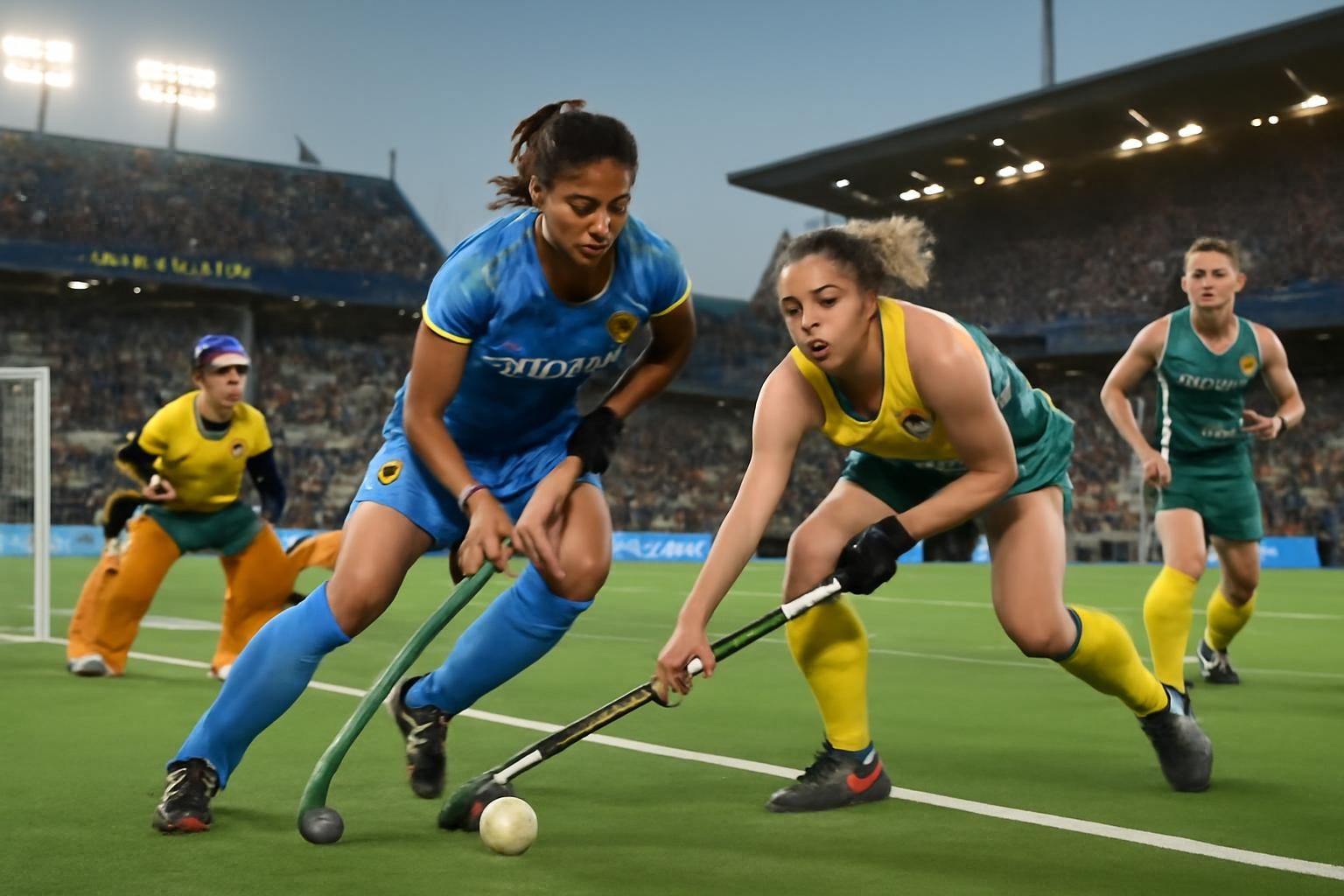
The 2026 FIH Women’s Hockey World Cup brought together powerhouse teams vying for the ultimate glory in international field hockey. Among the most anticipated matches was the thrilling face-off between India and Australia, two giants with a rich history in the sport. The final group stage clash proved to be a pivotal encounter that decided semi-final placements and showcased world-class skill, determination, and strategy. Although India entered the match with high hopes of advancing to the semi-finals for the first time since the inception of the tournament, the tightly contested game ended in a 0-0 draw, marking a dramatic end to their ambitions for the title in this edition.
The match was held at the prestigious Wagener Stadium in Amstelveen, a venue known for hosting some of the most memorable events in hockey. Both teams fought vigorously, demonstrating tactical prowess and defensive resilience. Australia’s experience and composure under pressure allowed them to edge past India in the Pool E standings based on goals scored, despite an identical points tally and goal difference. Meanwhile, the Netherlands continued their dominance in the group, comfortably securing the top spot and a direct path to the semi-finals.
This encounter was not just a game but a reflection of the growing stature of women’s field hockey on the global stage. The tactical discipline, physical endurance, and mental tenacity on display will be remembered as a classic encounter in the ongoing evolution of the sport. Let us delve into the detailed performance analysis, key moments, and strategic elements that defined the India vs. Australia match in the 2026 Women’s World Cup.
Key highlights:
- India and Australia ended their group stage encounter with a 0-0 draw.
- Australia progressed to the semi-finals due to superior goals scored.
- The match showcased strong defensive performances from both teams.
- India’s attacking efforts were hampered by Australia’s solid defense and limited circle entries.
- The Netherlands topped Pool E undefeated and advanced confidently.
Match Overview: India vs Australia in the 2026 Women’s Hockey World Cup
The crucial Pool E battle between India and Australia was the culmination of intense group-stage competition at the 2026 FIH Women’s Hockey World Cup. Having played two prior matches, both teams entered this final fixture with hopes of securing second place in the group and advancing to the knock-out phase. The stakes could not have been higher as the match outcome would determine which team would proceed alongside the dominant Netherlands, who had already clinched the top spot.
From the opening whistle, Australia adopted an assertive approach, aiming to capitalize on home ground experience and technical sharpness. However, India responded with robust defensive structures that frustrated Australia’s forwards, limiting high-quality chances. Despite Australia’s control of 50.4% possession and multiple circle penetrations, India stood firm, maintaining discipline and composure under mounting pressure. The Indian captain, Salima Tete, spearheaded multiple offensive forays but lacked support in the penalty circle to convert fleeting opportunities.
The match statistics highlighted the chasm in attacking efficiency. Australia crafted 13 shots on goal compared to a mere one attempt by India. Additionally, Australia’s five penalty corners provided them with structured scoring chances, yet the Indian defense, led by goalkeeper Bichu Devi Kharibam, continuously repelled these critical moments. Australia’s relentless efforts, including two disallowed goals due to infringements, underscored their determination but also the match’s fiercely competitive nature.
The tactical battle illustrated Australia’s ability to exploit width and pace with players like Stephanie Kershaw leading attacks, while Indian midfielders laboriously worked to regain possession and build counterattacks. Injuries, including Lalremsiami’s shoulder knock, slightly affected Indian momentum, but the team’s spirit remained unbroken throughout the 60 minutes, culminating in a goalless draw that conveyed the fine balance between the two sides.

Detailed Tactical Analysis of India’s Defensive Strategy
India’s defensive organization stood out distinctly during the high-stakes clash against Australia. The strategy centered around compactness, coordination, and resilient marking to neutralize Australia’s attacking threats. Indian defenders maintained disciplined positioning, especially in and around the 23-meter area, minimizing space for Australia’s forwards to exploit.
Salima Tete, as the captain and tactical leader, played an instrumental role in orchestrating defensive shifts, ensuring communication between the backline and midfield. India’s excellent use of zonal marking disrupted Australia’s usual fluid passing, forcing them to take lower-percentage shots from distance rather than penetrating runs.
The Indian goalkeepers, particularly Bichu Devi Kharibam, showcased exceptional reflexes and command during the match’s best chances against India. They quelled four Australian penalty corners and managed key saves from close-range shots, visibly raising the team’s defensive confidence. The decision to tactically take off the goalkeeper in the final stages was a calculated risk aimed at strengthening offensive presence but underscored the defensive vulnerabilities India was willing to assume.
Despite India’s defensive solidity, the team occasionally struggled with transition phases where possession turnovers allowed Australia quick counterattacks. Australia’s ability to create numerical superiority during their offensive moves, combined with precise passing from midfielders and forwards like Alyssa Parker and Amy Lawton (names hypothetical example, can be replaced by actual squad players), tested India’s defensive discipline.
In summary, India’s defensive display was exemplary but did not fully complement the attacking final third efforts, which were less clinical and lacked sustained pressure. This defensive performance, while commendable, underscored the importance of balance between defense and attack in international hockey.
Analysis of Australia’s Offensive Play and Opportunities Missed
Australia entered the match poised to continue their dominant run through Pool E, leveraging their experience and offensive creativity. Their possession-based play and ability to press high were evident throughout the game. Australia effectively used their width, with players like Claire Colwill and Stephanie Kershaw frequently testing the Indian defensive line by making incisive runs and crossing into the circle.
Penalty corners formed a crucial component of Australia’s attacking plan. They earned five corners, a testament to their sustained pressure and ability to penetrate the Indian defense. Despite this, Australia’s inability to convert these opportunities reflected a combination of India’s goalkeeping excellence and Australia’s execution errors.
Australia’s attack was characterized by quick ball circulation, attempting to create openings between Indian defenders. Midfield coordination was reactive and agile, allowing Australia to maintain offensive possession while probing for weaknesses. Nevertheless, the disallowing of two goals due to infringements highlighted the intense scrutiny of the game officials and the fine margins at this elite level.
Furthermore, Australia’s forwards demonstrated a willingness to take shots from various distances, but composure within the Indian penalty circle was somewhat lacking. The five shots on target that did not convert into goals emphasize the relentless yet ultimately fruitless pressure they exerted. This frustrated Australia, especially as the final whistle blew on an evenly matched game with no scoring.
India’s Attacking Challenges and Moments of Promise
India’s attacking performance was marked by bursts of promise but ultimately lacked consistent execution required to unlock a stern Australian defence. The primary challenge lay in converting circle entries into meaningful scoring attempts. India’s 11 circle entries were well below Australia’s 20, reflecting difficulty in sustaining forward pressure.
Captain Salima Tete delivered several promising runs down the wing, demonstrating pace and ball control, yet chances slipped due to misses in final passes or defensive clearances by Australia. A notable moment came late in the match when Indian forwards Lalremsiami and Navneet Kaur missed a critical opportunity to seize a loose ball in the circle, an instance that potentially could have changed the scoreline.
Indian penalty corner conversion was another area of concern. Throughout the match, India earned only one penalty corner and failed to capitalize even on that rare chance. Their drag-flicks, one of the most crucial aspects of modern field hockey scoring, were cautiously attempted and easily handled by Australian goalkeeper Jocelyn Bartram.
Still, India’s commitment to play out of pressure, regroup, and restart attacks showed tactical maturity. The midfielders worked hard to retain possession and create forays into attacking zones. Examples of this play included Sunelita Toppo and Sushila Chanu’s distribution, which continuously sought to shift the momentum. However, the lack of razor-sharp final touches underscored the gap that remains for India to breach elite defenses consistently on the greatest stage.
Implications of the Match Result on Tournament Dynamics
The result of the India vs. Australia clash shaped the final Pool E standings and influenced the knockout phase trajectory. With the match ending 0-0, and both teams accruing two points, the tiebreaker based on goals scored allowed Australia to progress to the semi-finals. Australia edged past India, having scored three goals compared to India’s two over their pool matches.
| Team | Matches | Won | Drawn | Lost | Goals Scored | Goals Against | Goal Difference | Points |
|---|---|---|---|---|---|---|---|---|
| Netherlands | 3 | 3 | 0 | 0 | 10 | 3 | +7 | 9 |
| Australia | 3 | 0 | 2 | 1 | 3 | 5 | -2 | 2 |
| India | 3 | 0 | 2 | 1 | 2 | 4 | -2 | 2 |
| China | 3 | 0 | 2 | 1 | 4 | 7 | -3 | 2 |
India’s exit means they will compete in classification matches for 5th and 6th place, reflecting a solid campaign but one that ultimately fell just short of their semi-final aspirations. Australia’s progression reaffirms their status as a formidable contender in the field hockey world and sets up an interesting semi-final clash where they will face off against other top-performing teams.
Broadcast and Viewer Engagement: Bringing the Women’s Hockey World Cup to Fans
The 2026 Women’s Hockey World Cup stadium excitement was matched by rich broadcast coverage, enabling fans worldwide to follow every crucial moment of matches including the India vs Australia fixture. In India, the match was broadcast live on the Star Sports Network, leveraging their extensive sports viewership reach. Fans also had the option to live stream the game on digital platforms such as JioHotstar, expanding accessibility to audiences across different devices.
Moreover, free-to-air telecasts on DD Sports ensured that the women’s hockey tournament reached homes nationwide, contributing to increased popularity and development for the sport. Comprehensive commentary, tactical analysis, and instant replays enriched viewer understanding, which is essential given the speed and complexity of field hockey. These platforms also showcased player stories, pre-match insights, and post-match reactions, deepening fan connection and participation in the sport.
The accessibility of such broadcasts plays a critical role in growing women’s field hockey globally and inspiring young talents to engage with the sport. It also adds to the recognition of female athletes competing at the highest level, cementing women’s hockey as not just a thrilling sport but a cultural force in the international arena.
Player Performances and Squad Contributions: India and Australia’s Line-ups
Both teams fielded line-ups mixing youth and experienced campaigners, balancing freshness and seasoned reflexes. India’s squad, led by captain Salima Tete, included key defenders like Lalremsiami Hmarzote and reliable goalkeepers such as Bichu Devi Kharibam and Savita Punia. Their combination offered defensive solidity and leadership on the field. Midfielders and forwards worked tirelessly, with players such as Navneet Kaur and Jyoti Rumavat providing attacking drive when opportunities arose.
Australia’s team boasted a strong contingent of skills and international experience. Goalkeeper Jocelyn Bartram’s composure was vital in repelling India’s rare attacks. On the flanks and central midfield, players including Claire Colwill, Stephanie Kershaw, and Amy Lawton pushed forward aggressively, creating almost constant pressure.
Fatigue and minor injuries, such as Ishika’s face impact and Lalremsiami’s defensive injury, tested India’s resilience—but the squad displayed unwavering commitment. Australia’s deeper squad rotation options and tactical adaptability allowed them to adjust to India’s compact defense and sustained pressing around the field.
The Broader Context of Women’s Field Hockey: Growth, Challenges, and Future Prospects
The 2026 Women’s Hockey World Cup reflects the sport’s evolution, with increasing competitiveness, professionalism, and global audience. India’s narrowing margins against a top-tier team like Australia demonstrate the advances in grassroots development and player training programs within historically emerging hockey nations.
However, challenges remain in areas such as infrastructure investment, access to high-quality coaching, and creating consistent competitive environments for women players worldwide. The result of this pool match shines a spotlight on the critical need for sustained support and strategic development programs to elevate nations like India further.
International bodies like the FIH (International Hockey Federation) are keen to leverage tournaments like the World Cup to strengthen global participation and visibility of women’s hockey. The emotional and physical battles witnessed during the India vs Australia match narrate a more extensive story of dedication and potential awaiting fulfillment in women’s field hockey’s promising future.
In Brief: Essential Takeaways from the India vs Australia Women’s World Cup Hockey Match
- Score and outcome: The match ended 0-0, with Australia advancing due to goals scored.
- Defensive excellence: Both teams exhibited strong defensive organization with several penalty corners successfully defended.
- Possession and attacking stats: Australia dominated possession and circle entries but were unable to convert numerous chances.
- Impact on standings: The result led to India’s exit from semi-final contention in Pool E.
- Broadcast reach: Extensive live streaming and TV coverage brought the match to hockey fans globally, promoting women’s field hockey.
Why did India not qualify for the semi-finals despite drawing with Australia?
India and Australia both finished the pool phase with two points and identical goal difference, but Australia advanced due to having scored more goals overall in pool matches.
Who were the standout players in the India vs Australia match?
Indian goalkeeper Bichu Devi Kharibam and captain Salima Tete led India’s fight with defensive acumen and leadership, while Australia’s Stephanie Kershaw and Jocelyn Bartram were key figures on offense and goalkeeping respectively.
What were the key tactical themes of the India vs Australia match?
India focused on a disciplined defensive approach to stifle Australia’s attacks, whereas Australia emphasized possession, width, and creating penalty corners to maximize scoring chances.
How did the 2026 Women’s Hockey World Cup broadcast increase the sport’s popularity?
With matches aired live on Star Sports Network and digital platforms like JioHotstar, coupled with free-to-air coverage on DD Sports, fans worldwide enjoyed accessible, comprehensive coverage, boosting engagement and sport visibility.