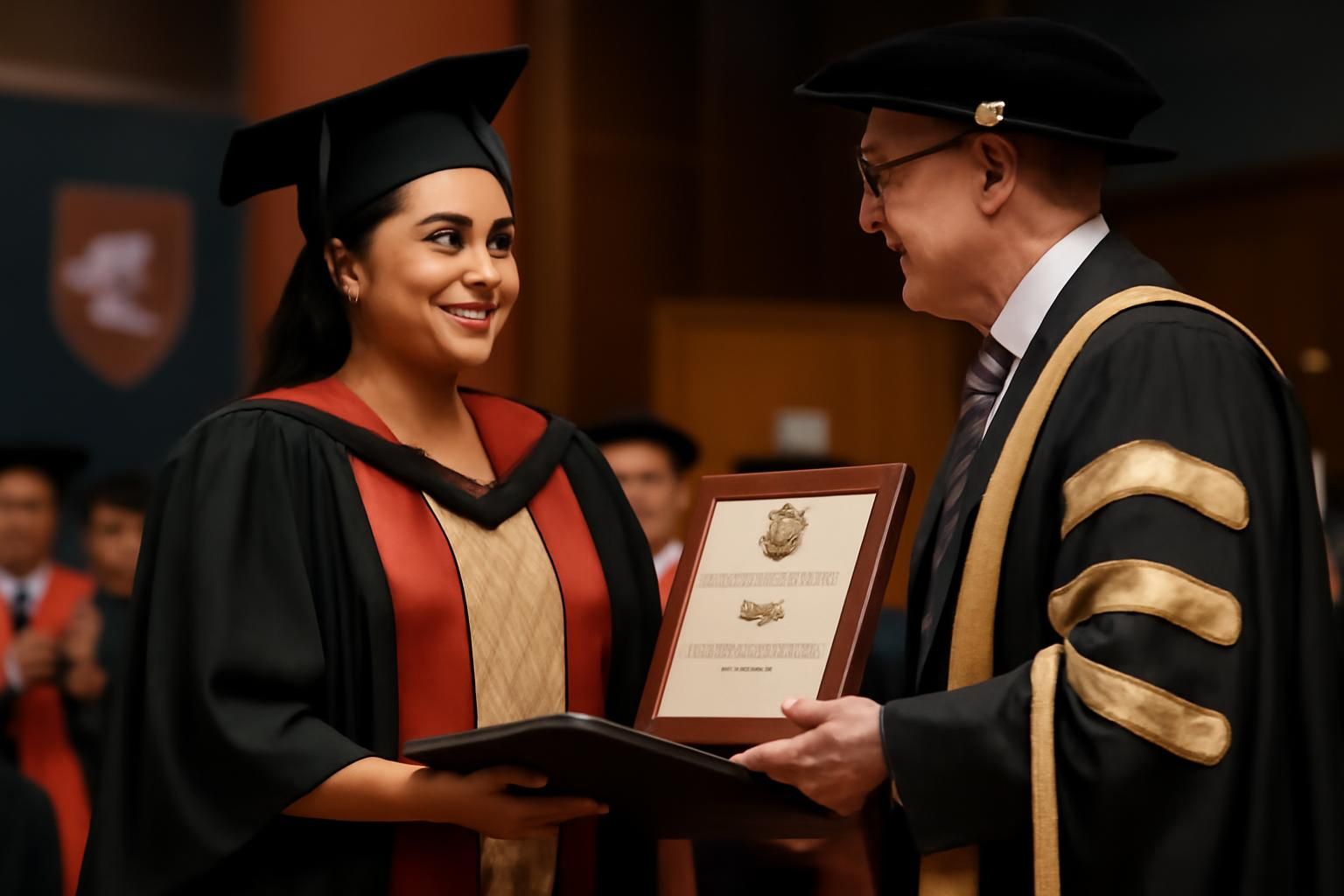
Rani Mukerji, one of Bollywood’s most revered actresses, recently received an Honorary Doctorate from La Trobe University in Australia, a significant accolade that honors her exemplary contributions to Indian cinema and her impactful roles beyond the screen. This distinguished recognition was presented during the Indian Film Festival of Melbourne (IFFM) 2026, underlining her stature as a pivotal figure in bridging cultural narratives through film. The event magnified her artistic journey that has spanned nearly three decades and celebrated the power of cinema in fostering empathy and understanding across global audiences.
Alongside this prestigious award, Mukerji was also bestowed a Special Citation for her outstanding acting excellence at the same festival. This dual recognition at the IFFM highlights her remarkable ability to infuse her roles with profound emotional depth while championing social causes, reinforcing her status as both a cinematic icon and a compassionate advocate. Her achievements reflect not only personal milestones but also broader cultural accomplishments, with the Australian university ceremony demonstrating the long-standing ties and mutual appreciation between the Indian and Australian cinematic communities.
Key Highlights:
- Rani Mukerji honored with an Honorary Doctorate by La Trobe University, recognizing her decades-long contributions to cinema and activism.
- She is the second Indian film personality after Shah Rukh Khan to receive this distinction from the university.
- The Indian Film Festival of Melbourne (IFFM) awarded her a Special Citation for acting excellence, emphasizing her three decades of memorable performances.
- Mukerji’s work transcends acting, focusing on advocacy for women, children, and social empowerment through storytelling.
- The festival and the award symbolize the deepening cultural connection between India and Australia in 2026.
Honoring Rani Mukerji: The Significance of the La Trobe University Honorary Doctorate
Receiving an Honorary Doctorate from La Trobe University marks a monumental milestone in Rani Mukerji’s career and for Indian cinema in Australia’s cultural landscape. This university has a history of celebrating global art forms and recognizes individuals who have transcended conventional frameworks through groundbreaking work and meaningful societal contributions. Awarding Mukerji this honor is a testament to her sustained excellence and the immense impact cinema can have beyond entertainment.
La Trobe University’s choice to confer this doctorate upon Mukerji underlines her exceptional three-decade career, which seamlessly blends commercial success with critically acclaimed performances. Unlike many celebrities who view acting solely as a profession, Mukerji embraces her role as a cultural ambassador and advocate. Her dedication to portraying complex female characters has not only entertained millions but also challenged stereotypes and elevated societal dialogues about women’s rights and inclusivity within Indian society and beyond.
Moreover, this honor complements other cultural bridges built by La Trobe University, such as its previous recognition of superstar Shah Rukh Khan in 2019. Just as Khan’s award acknowledged his philanthropic efforts and cinematic eminence, Mukerji’s doctorate acknowledges her artistic innovation alongside her commitment to social advocacy. The institution’s recognition echoes the philosophy that cinema can indeed influence hearts and stimulate progressive change, a belief Mukerji embodies through her career choices and public engagements.
The awarding ceremony itself, held at Melbourne’s Federation Square during the ongoing Indian Film Festival, symbolized a beautiful confluence of Indian storytelling and Australian multiculturalism. It attracted filmmakers, critics, and cinema lovers from both countries, further cementing Mukerji’s status as a transnational cultural icon whose work catalyzes mutual understanding between diverse audiences.

Rani Mukerji’s Cinematic Journey: Decades of Transformative Roles
A substantial component of Rani Mukerji’s recognition is anchored in her profound and versatile filmography that has carved a niche in contemporary Indian cinema. Beginning her career as a young actress, Mukerji chose roles that resonated personally with her ethos, seeking stories that moved audiences emotionally and intellectually.
Some of her groundbreaking films include the critically acclaimed “Black” – a poignant story highlighting disability and resilience – and “No One Killed Jessica,” which tackled injustice and media trials in Indian society. These films did not merely serve as entertainment but became catalysts for social conversations, underscoring Mukerji’s commitment to meaningful cinema.
Her roles in commercial hits like “Hum Tum” and “Bunty Aur Babli” demonstrated her ability to balance mass appeal with nuanced performances, appealing to diverse audiences. Furthermore, franchises such as “Mardaani” showcase her dedication to strong, fearless female leads confronting societal challenges like crime and gender violence.
The diversity within her portfolio has made these films travel beyond Indian borders, garnering international attention and contributing to Bollywood’s global legacy. Each character she brought to life carried themes of hope, empowerment, and transformation that audiences worldwide connected with emotionally.
This sustained excellence over three decades has not only earned her a plethora of awards but also deep admiration from industry peers and critics alike. Rani Mukerji’s art has continually innovated the language of Indian cinema by injecting social consciousness alongside artistry.
Notable Films and Their Impact
- Black: Raised awareness about disability representation and emotional resilience.
- No One Killed Jessica: Highlighted systemic failures and sparked public discourse on women’s justice.
- Hum Tum: Blended romance with urban Indian youth culture, gaining popular appeal.
- Mardaani franchise: Empowered women’s narratives combating crime and societal fears.
- Mrs. Chatterjee vs Norway: Showcased diaspora struggles and maternal bravery.
Contribution Beyond the Screen: Rani Mukerji’s Advocacy and Social Impact
Recognition through an Honorary Doctorate extended beyond Rani Mukerji’s cinematic achievements to acknowledge her extensive social advocacy work. Throughout her career, she has leveraged her public platform to champion women’s rights, child welfare, and other human rights causes. These efforts resonate in India and across the global communities she influences.
Mukerji’s engagements represent a powerful example of how celebrities can harness their visibility for positive change. She frequently participates in campaigns that address education, gender equality, and domestic violence prevention. Her efforts reinforce the intimate power dynamics portrayed in some of her most iconic roles by translating awareness into tangible support and action.
By intertwining her advocacy with her artistic identity, Mukerji highlights that actors embody responsibilities that reach far beyond their performances. She often stresses that artists “quietly become ambassadors of our culture,” and her example illustrates how cinema serves as a global language for empathy and dialogue.
This alignment of art and activism has encouraged other artists to view their contributions holistically, creating a ripple effect that strengthens the social fabric tied to cinema. Rani Mukerji’s work on and off-screen embodies the ethos that the artist’s role involves nurturing understanding, compassion, and empowerment.
The Indian Film Festival of Melbourne (IFFM): Celebrating Bilateral Cultural Exchange
The Indian Film Festival of Melbourne (IFFM) is a cornerstone event celebrating the wealth and vitality of Indian cinema in Australia. The festival not only showcases the latest cinematic works but also honors veterans like Rani Mukerji whose careers enriched the medium globally. The 2026 edition, spanning from August 13 to 23, featured a diverse slate of Indian filmmakers and films representing the country’s cultural plurality.
Hosting the honorary ceremony for Mukerji amidst the festival amplified the dialogue between audiences and artists from both nations. The festival’s programming emphasizes storytelling as a shared human heritage, transcending geographical and cultural boundaries. IFFM’s focus on themes around social change, representation, and artistic innovation mirrors Mukerji’s personal career trajectory and values.
The festival’s role in cultural diplomacy cannot be overstated. It fosters connections that facilitate collaboration, distribution, and appreciation of Indian cinema within a multicultural Australian context. By awarding Mukerji a special citation for acting excellence, the festival acknowledged her global impact and the universal themes present in her films.
Events like panel discussions, workshops, and retrospectives held alongside screenings at IFFM create spaces where artists and audiences engage deeply, reflecting on cinema’s role as a medium for empathy and transformation. These interactions enrich both communities, enhancing mutual respect and understanding.
How Rani Mukerji’s Work Resonates Globally: The Universal Language of Cinema
Rani Mukerji’s international acclaim underscores cinema’s capacity to cross borders and connect diverse cultures through storytelling. Her films have resonated worldwide, particularly in Australia, where she was honored, symbolizing how stories rooted in Indian culture can speak universally.
Their emotional narratives about human experiences such as love, struggle, and resilience strike chords with audiences of varied backgrounds. This global resonance positions Mukerji as more than a national icon but as a global storyteller whose work fosters empathy across cultural divides.
Australia’s embrace of Mukerji’s work is reflective of a broader trend where Indian cinema often serves as a cultural bridge, bringing Indian heritage and contemporary issues into international focus. This interaction enriches Australian multiculturalism and offers Indian artists avenues for wider recognition and influence.
Moreover, Mukerji’s approach to choosing roles based on stories that inspire and empower reflects a conscious artistic philosophy. She aims to cultivate dialogue and empathy, demonstrating that cinema has transformative potential when it reflects nuanced social realities and honors diverse voices.
This widespread connection also highlights the increasing globalization of film industries, with audiences seeking authentic stories that blend local flavor with universal emotions.
Films That Sparked International Conversations
- No One Killed Jessica: Sparked debate on legal and media ethics globally.
- Black: Influenced discussions on disability rights and representation internationally.
- Mardaani: Brought attention to women’s safety issues worldwide.
Details of the Honorary Doctorate and Special Citation Awards
The Honorary Doctorate awarded by La Trobe University is formally titled Doctor of Letters (D.Litt.), an academic degree recognizing outstanding contributions to the arts and culture. Mukerji’s citation emphasizes her nearly 30 years of excellence in cinema alongside her commitment to social advocacy.
The accompanying Special Citation from the Indian Film Festival of Melbourne highlights her “acting excellence” that has left an indelible mark on the industry and audience hearts globally. These combined awards underline her unique role as both an artist and cultural ambassador.
Below is a summary table detailing these honors:
| Award | Issuing Body | Criteria | Significance |
|---|---|---|---|
| Honorary Doctorate (Doctor of Letters) | La Trobe University | Lifetime achievements in cinema and social advocacy | Recognition of cultural and artistic excellence; strengthening India-Australia ties |
| Special Citation for Acting Excellence | Indian Film Festival of Melbourne (IFFM) | Commitment to impactful performances over three decades | Celebrates international cinematic influence and artistic contribution |
Reflecting on Cultural Diplomacy: Cinema as a Bridge Between Nations
The conferment of these honors on Rani Mukerji is a testament to cinema’s power in cultural diplomacy. Films and artists serve as vital conduits for fostering global cultural exchange, a truth profoundly embodied by Mukerji’s career.
By hosting the ceremony during the Indian Film Festival of Melbourne, Australia reinforced its embrace of India’s rich cinematic heritage while broadening its multicultural fabric. Mukerji’s narrative and advocacy have served as soft power tools that promote a positive image of India and inspire cross-cultural conversations.
This event enriches bilateral relations, encouraging collaboration in artistic ventures, academic exchanges, and community engagement. The growing recognition of Indian cinema in international arenas like Australia’s La Trobe University facilitates opportunities for other artists and paves the way for inclusive global narratives.
Overall, Mukerji’s awards symbolize more than personal accolades—they reflect a shared celebration of cinema’s ability to transcend borders and create lasting cultural connections.
Legacy of Rani Mukerji: Inspiring Future Generations of Artists
Rani Mukerji’s career is a beacon for aspiring actors and filmmakers. Her dedication to selecting meaningful roles and promoting social causes serves as a guiding example for the next generation. This honorary recognition reinforces the importance of perseverance, artistic integrity, and civic responsibility.
Her story encourages young artists to view their craft as both a creative outlet and a platform for change. Beyond box office numbers and glamour, Mukerji embodies how cinema can play a role in shaping societal perceptions and inspiring action.
Her involvement with community projects and advocacy initiatives, combined with her successful filmography, underscores that professional achievement and social contribution are not mutually exclusive but interconnected goals.
As artists worldwide look to her achievements, this award marks a milestone that celebrates not only Mukerji’s personal journey but the evolving narrative of Indian cinema and its growing influence on global culture. Her legacy invites emerging talent to dream expansively and engage deeply with issues beyond the screen.
Who conferred the Honorary Doctorate on Rani Mukerji?
La Trobe University in Australia awarded Rani Mukerji the Honorary Doctor of Letters in recognition of her contributions to cinema and social causes.
What is the significance of the Special Citation from IFFM?
The Special Citation acknowledges Rani Mukerji’s exceptional acting excellence throughout her nearly three-decade career, celebrating her impact on Indian cinema and international audiences.
How has Rani Mukerji contributed to social advocacy?
Beyond acting, Mukerji has actively supported women’s rights, child welfare, and other social causes, using her platform to raise awareness and promote empowerment.
What role does the Indian Film Festival of Melbourne play in cultural exchange?
IFFM serves as a vital cultural bridge between India and Australia, showcasing Indian cinema and fostering dialogue, collaboration, and mutual appreciation.
Which films highlight Rani Mukerji’s impact on social issues?
Films like ‘Black,’ ‘No One Killed Jessica,’ and the ‘Mardaani’ franchise are key examples where Mukerji’s performances address disability rights, legal justice, and women’s safety.