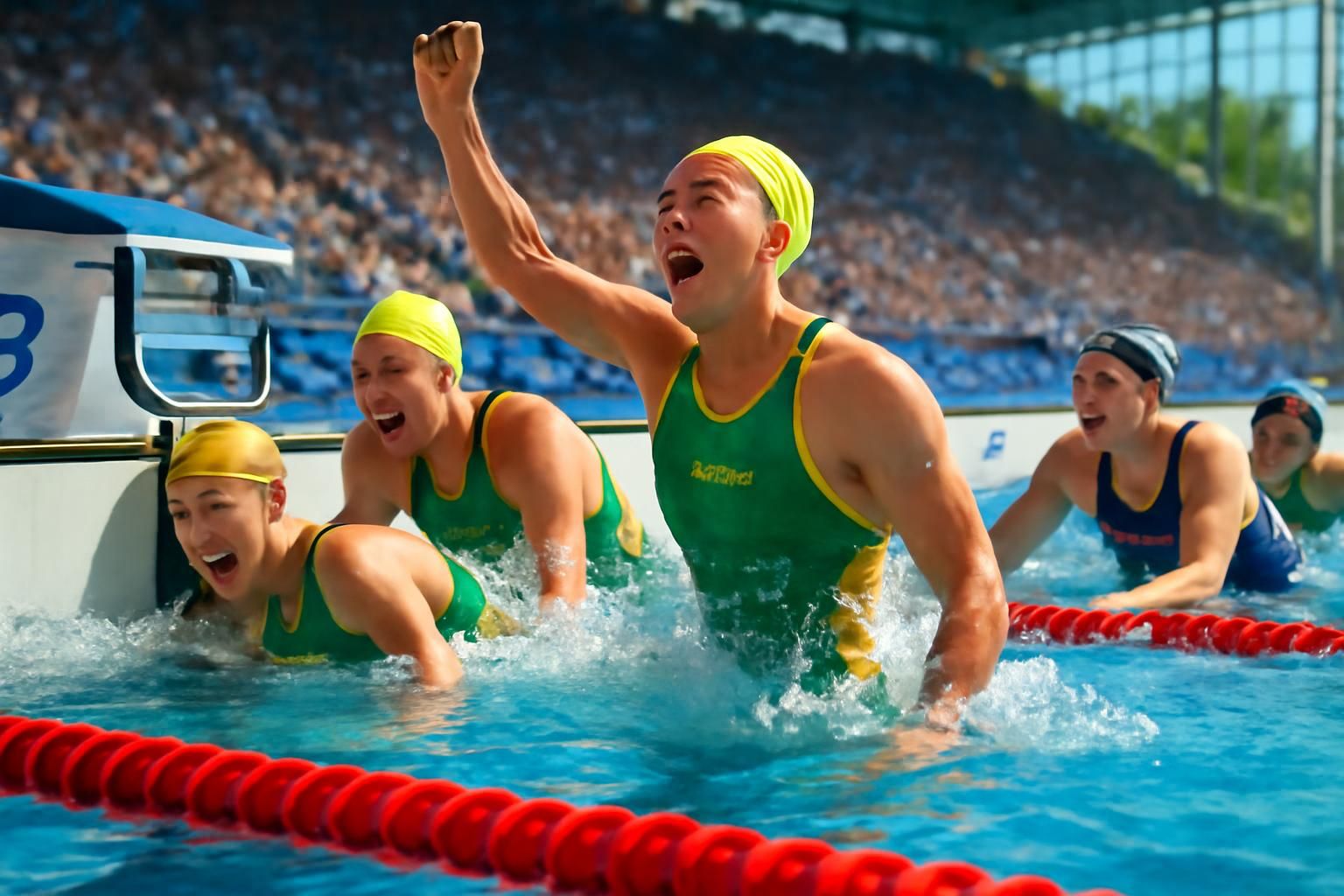
The women’s 4x200m freestyle relay at the 2025 World Aquatics Championships in Singapore provided a spectacle of competitive swimming that thrilled fans worldwide. Marking a significant moment in the swimming calendar, Australia edged out the United States in a nail-biting finish that was decided by less than a second. The Australian quartet, led passionately by Mollie O’Callaghan and her teammates Lani Pallister, Jamie Perkins, and Brittany Castelluzzo, delivered an extraordinary performance, showcasing impeccable technique, team synergy, and unyielding determination in the pool.
This victory carried more weight than just a gold medal; it signified Australia’s continuing rise as a powerhouse in women’s swimming, and Mollie O’Callaghan’s historic achievement of equalling Ian Thorpe’s Australian record of 11 swimming world championship gold medals further amplified the triumph. The United States, always a dominant force in swimming, gave a fierce challenge, with iconic athlete Katie Ledecky anchoring their team in pursuit of victory. China’s close third finish added to the formidable competition dynamic.
Brief Highlights:
- Australia wins women’s 4x200m freestyle relay at the 2025 World Aquatics Championships in Singapore.
- Mollie O’Callaghan matches Ian Thorpe’s record of 11 world championship gold medals.
- The final was decided by a mere 0.66 seconds, underscoring a thrilling international relay competition.
- Key swimmers included Lani Pallister, Jamie Perkins, Brittany Castelluzzo, and Mollie O’Callaghan for Australia, with Katie Ledecky anchoring the U.S. relay team.
- China closely followed with a strong third-place finish, showcasing the global depth in women’s swimming.
Unpacking the Strategy Behind Australia’s Women’s 4x200m Freestyle Relay Victory
Australia’s win in the women’s 4x200m freestyle relay was the culmination of meticulous planning and strategic prowess. Every relay team aims for a perfect balance of speed, endurance, and flawless transitions, and Australia’s squad executed this with precision. The 4x200m relay is unique in that it demands each swimmer to maintain a high-velocity pace over a longer distance than the sprint relays, testing both aerobic capacity and tactical pacing.
The Australian coaching team focused on swimmer order to maximize both momentum and psychological advantage. Placing strong starters like Lani Pallister set the tone early, generating an initial lead or putting pressure on the US team. Jamie Perkins and Brittany Castelluzzo solidified the position, conserving the team’s edge with consistent, reliable splits. The final leg featured Mollie O’Callaghan, Australia’s sprint powerhouse and record-equalling athlete, entrusted to anchor the relay with resilience and a killer instinct.
This strategic deployment leveraged the strengths of each swimmer, ensuring the presence of explosive speed when it mattered most without compromising consistent middle legs. Notably, Mollie’s sprint finish was key to fending off the relentless challenge from Katie Ledecky — widely regarded as one of the greatest middle-distance swimmers in history. Their head-to-head duel during the last 50 meters enthralled spectators and was a testament to Australia’s tactical acumen.
The role of start and exchange technique is often underappreciated in relay events, but Australia’s practice in optimizing takeovers allowed them to shave precious milliseconds off their total time. This aspect contributed directly to their narrow victory margin, highlighting that strategic precision goes hand-in-hand with athletic performance at the highest level.

Mollie O’Callaghan: The Record-Equalling Sensation Anchoring Australia’s Triumph
Mollie O’Callaghan has rapidly become a defining figure in contemporary swimming, exemplified by her recent achievement of matching Ian Thorpe’s legendary record of 11 world championship gold medals. Anchoring the women’s 4x200m freestyle relay, her presence was both inspiring and decisive.
Her journey in swimming reflects a mix of talent, durability, and nerves of steel. Over several international competitions, Mollie has honed a signature sprint finish that involves well-timed bursts of speed and a remarkable ability to maintain technique under pressure. This combination allows her to gain vital ground in the closing stages of a race, as vividly demonstrated against the U.S.’s Katie Ledecky.
O’Callaghan’s success can also be linked to her training environments in Queensland, where she developed under expert coaches who emphasized technical skill development alongside endurance conditioning. Her record-equalling accomplishment not only symbolizes personal excellence but also places her in the pantheon of Australian swimming legends, underscoring the nation’s rich tradition of producing world-class athletes.
Her performance in Singapore also highlights an evolving trend in women’s swimming: the rise of young athletes capable of challenging established veterans and rewriting record books. Mollie O’Callaghan’s role as the anchor bore immense pressure but highlighted her composure and competitive maturity. Her victory lap was not just about speed but also strategy, mental strength, and a deep commitment to team success.
The Heightened Rivalry Between Australia and the U.S. in Women’s Swimming Relays
The rivalry between Australia and the United States in women’s swimming relays is both historic and fiercely competitive, with each nation pushing the other to new heights of performance. This rivalry is a captivating storyline at international meets, often setting the stage for high drama and thrilling finishes.
Over decades, both countries have built legacy programs boasting depth in talent, innovative training methodologies, and strong support systems for their athletes. These elements collectively contribute to their consistently high rankings in global championships.
The 2025 showdown in Singapore served to reignite this rivalry, with Australia’s narrow victory by 0.66 seconds conveying the very fine margins separating two world-class teams. It underlines how much effort and preparation both sides invest in relay setups, often engaging in psychological mind games and tactical ploys to unsettle their opponents before races.
Furthermore, these contests offer a unique mix of individual brilliance and collective teamwork. Unlike individual races, relay victories require seamless exchanges, trust among teammates, and shared motivation. Australia’s win not only reaffirmed their relay proficiency but also redefined the competitive balance with the U.S., promising more riveting clashes in future championships.
Technical Breakdown: Swimming Techniques and Training for the 4x200m Freestyle Relay
The 4x200m freestyle relay is a complex event that goes beyond sheer speed. The discipline demands a refined blend of endurance, stroke efficiency, and race strategy, all of which must be optimized to secure victory in world-class competitions.
A typical training regimen for elite swimmers targeting this event integrates high-volume aerobic conditioning with anaerobic sprint work. Swimmers improve their lactate threshold to endure the length of their 200m segment while developing the capacity for bursts of speed during starts and finishes.
In terms of technique, freestyle swimmers focus on streamlining, consistent stroke rate, and minimizing drag during turns and underwaters. Efficient flip turns and fast breakout strokes provide essential seconds in races decided by fractions of a second.
Practicing relay takeovers is equally critical. Teams dedicate hours refining timing so that the incoming swimmer touches the wall at the exact moment the outgoing swimmer launches, avoiding early starts or delays. This meticulous coordination serves as a valuable asset that often distinguishes medal-winning relays.
Sport science advancements contribute significantly as well. Personalized biomechanical analyses and tailored training programs help athletes maximize their technique and prevent injuries. Australia’s relay squad is known for embracing such technology, which likely influenced their superior performance in Singapore.
The Global Impact of Australia’s Relay Victory on Women’s Swimming
Australia’s win over the U.S. extends its influence beyond the immediate event, reflecting the shifting paradigms in international women’s swimming. Countries worldwide observe such outcomes, adjusting their developmental programs and talent pipelines accordingly.
This victory spotlights Australia’s ability to cultivate a new generation of swimmers capable of challenging traditionally dominant powers. It also encourages young aspiring athletes, especially women, to engage in competitive swimming with the belief that achieving global success is possible.
Moreover, the relay result amplifies interest in swimming as a sport, potentially increasing funding and sponsorships globally. It triggers motivational narratives around teamwork, perseverance, and high achievement that resonate both within and outside the aquatic community.
The United States and China remain formidable opponents, but Australia’s growing proficiency indicates a healthy, competitive ecosystem that benefits the sport’s evolution. As nations continue to enhance training facilities and embrace emerging sciences, women’s swimming relays are poised for increasingly electrifying competitions.
Key Athletes Behind Australia’s Triumph: Profiles and Contributions
Australia’s 4x200m relay success was no accident but the result of collective talent and focused preparation. The four primary swimmers—Lani Pallister, Jamie Perkins, Brittany Castelluzzo, and Mollie O’Callaghan—each brought unique strengths to the team.
- Lani Pallister: Known for her aggressive opening splits and strong mid-distance capabilities, Pallister set the tone, putting early pressure on the U.S. competitors.
- Jamie Perkins: A dependable middle leg swimmer, Perkins maintains composure and consistency, ensuring Australia’s lead was protected through the middle laps.
- Brittany Castelluzzo: Castelluzzo exemplifies versatility and endurance, often bridging the gap between strategic pacing and power swimming to sustain team position.
- Mollie O’Callaghan: As the anchor, O’Callaghan combines experience, speed, and psychological fortitude to close out races under pressure effectively.
The team’s cohesive dynamics both in the pool and during practices played a pivotal role. Their understanding of each other’s race patterns and strengths allowed them to execute smooth transitions and react to race developments tactically.
Analysis of the 2025 World Aquatics Championships Women’s 4x200m Freestyle Relay Results
| Position | Country | Swimmers | Final Time | Margin to Winner (seconds) |
|---|---|---|---|---|
| 1 | Australia | Lani Pallister, Jamie Perkins, Brittany Castelluzzo, Mollie O’Callaghan | 7:39.35 | – |
| 2 | United States | Including Katie Ledecky | 7:40.01 | 0.66 |
| 3 | China | Various | Close behind | More than 2 seconds |
The winning time of 7:39.35 was not just a gold-winning effort but also set a new Championship Record, underlining the quality of performance. The close margin speaks volumes about the highly competitive nature of the event and the incremental improvements made by the Australian swimmers to achieve this edge.
Evolution and Future Outlook of Women’s 4x200m Freestyle Relay Competition
The women’s 4x200m freestyle relay has evolved considerably over recent decades. Initially dominated by a few traditional powerhouses, the event has grown more competitive with emerging nations investing heavily in swimming development programs.
The thrilling race between Australia and the U.S. in Singapore epitomized this shift. Increased athlete specialization, advanced training techniques, and data-driven performance monitoring have all played roles in elevating the standard of competition.
Looking forward, the relay is expected to produce even faster times as countries further embrace scientific advances like real-time biometric tracking and artificial intelligence to optimize swimmer performance. The rising depth of talent worldwide suggests a future where gold-medal finishes might be decided by hundredths of seconds regularly.
Additionally, with swimming governance bodies promoting gender equity and equal visibility in media, women’s relay events are becoming premier showcases for the sport. This attention brings enhanced commercial opportunities and inspiration for future generations of athletes.
What made Australia’s women’s 4x200m freestyle relay team successful in 2025?
Australia’s success was due to strategic swimmer order, flawless takeovers, strong individual splits, and Mollie O’Callaghan’s exceptional anchoring performance.
How close was the finish between Australia and the U.S. in the relay?
The race was decided by just 0.66 seconds, reflecting a very tight competition.
Why is Mollie O’Callaghan’s achievement significant?
She equalled Ian Thorpe’s Australian record of 11 swimming world championship gold medals, joining the country’s most elite swimmers.
What factors contribute to successful relay takeovers in swimming?
Precise timing, trust among teammates, and repeated practice of takeoff and exchange sequences minimize time lost during transitions.
How is the women’s 4x200m freestyle relay evolving in international competitions?
It is becoming increasingly competitive due to advancements in training, data analytics, athlete specialization, and global talent development.