
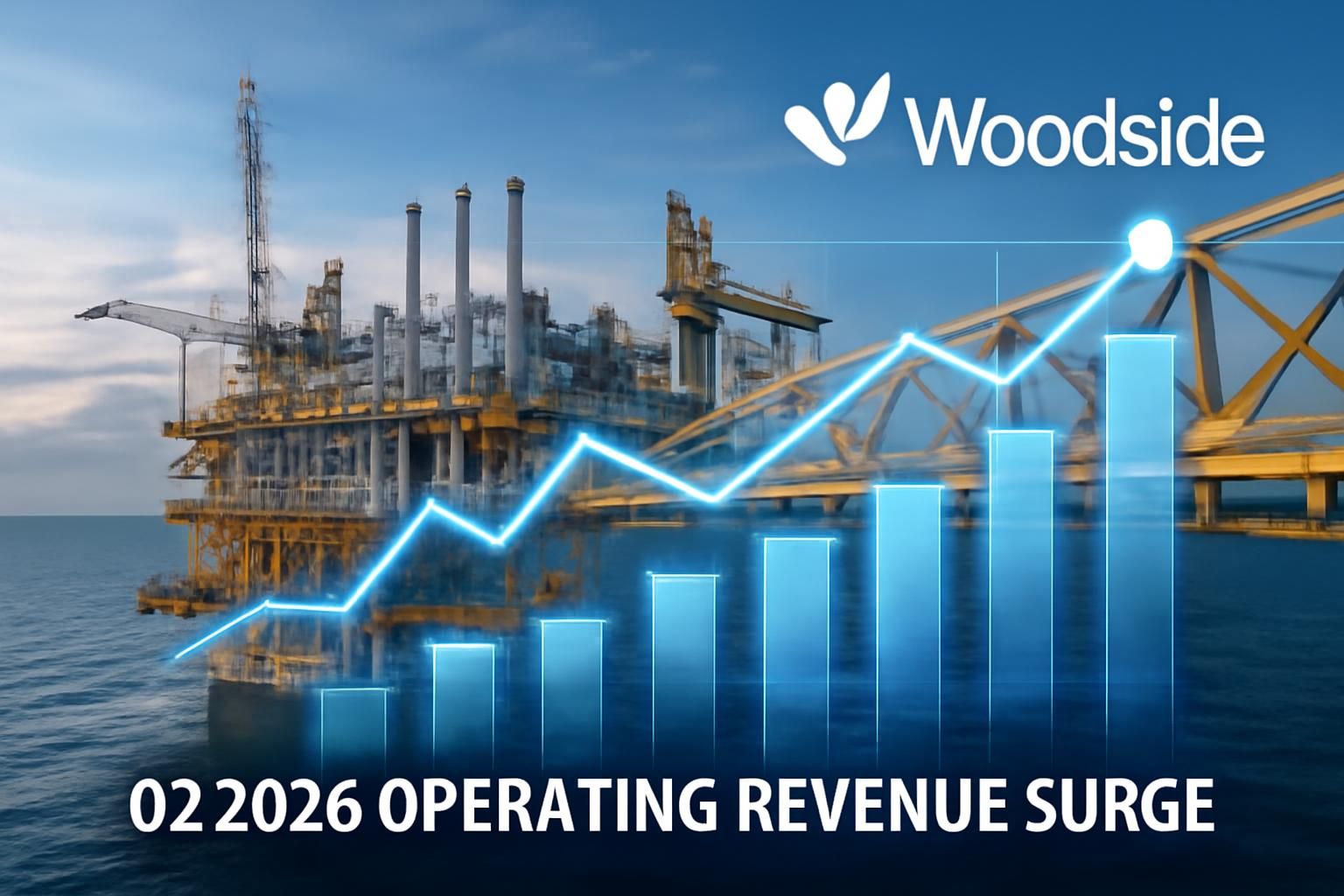
Woodside Energy has demonstrated significant financial growth in Q2 2026, reporting an impressive 28% surge in operating revenue compared to previous quarters. Closing the period with $4.18 billion, equivalent to approximately A$6.01 billion, this achievement highlights the company’s resilience within the volatile energy sector. Despite a slight decline in production volume, Woodside’s robust pricing strategy delivered a remarkable average realised price of $85 per barrel of oil equivalent (boe), marking a 44% increase year-on-year that greatly bolstered the business performance.
This quarterly results report underscores Woodside’s ability to effectively navigate fluctuating market conditions, strategic asset management, and ongoing investment in growth projects. Notably, production volumes adjusted to 41.3 million boe for the quarter, down 18% from 50.1 million boe in Q2 2025, influenced mainly by planned maintenance activities and recovery from environmental factors. Liquidity strength remains evident with cash reserves around $8.2 billion after a $600 million syndicated term loan repayment, while net debt, including lease liabilities, stands at $9.3 billion with a conservative gearing ratio of 21%.
Woodside’s operational excellence was also reflected in the reliability metrics across key assets such as Sangomar and Shenzi projects, both achieving over 99% operational efficiency. Moreover, strategic growth developments are progressing on schedule, including the near-completion of the Scarborough Energy Project, which is 98% finalized and slated to commence LNG cargo deliveries by Q4 2026. The company also continues to advance the Trion and Louisiana LNG projects, contributing to future supply and revenue streams in this ever-evolving market landscape.
This comprehensive overview of Woodside’s Q2 2026 performance paints a compelling picture of financial strength and operational success, positioning the company as a dynamic leader in the energy sector amidst ongoing macroeconomic and commodity price challenges.
- Operating revenue rose 28% to $4.18 billion in Q2 2026
- Average realised oil equivalent price increased 44% to $85/boe
- Production volumes decreased 18% due to planned maintenance
- Strong liquidity of $8.2 billion post debt repayment
- High operational reliability at major assets exceeding 97%
- Scarborough Energy Project near completion at 98%
- Growth projects Trion and Louisiana LNG advancing on schedule
- Conservative gearing ratio of 21% reflecting financial prudence
Evolution of Woodside’s Operating Revenue: Analyzing the 28% Surge in Q2 2026
Woodside’s 28% increase in operating revenue for the second quarter of 2026 signals a substantial financial upswing that is pivotal for stakeholders tracking performance in the energy sector. This surge from $3.27 billion in the same quarter of the previous year to $4.18 billion reflects not only improved market pricing but also strategic operational management amid external challenges. Such growth underscores the company’s adaptability and foresight in optimizing revenue streams despite production adjustments.
The dramatic rise in the average realised price to $85 per barrel of oil equivalent, a 44% hike over Q2 2025’s $59/boe, was a key driver behind the revenue increase. This pricing enhancement has demonstrated Woodside’s ability to capitalize on favorable market dynamics and maintain profitability. However, this acceleration of operating revenue occurred simultaneously with an 18% reduction in production volume down to 41.3 million barrels of oil equivalent due to planned maintenance and recovery phases, indicating a complex balance between volume and pricing strategies.
The relationship between revenue, realised price, and production volumes reveals Woodside’s strategic finesse during Q2 2026. While lower production might traditionally depress revenue, the company’s focus on maintaining higher realised prices compensated effectively. This presents a forward-looking model where maximizing product value trumps sheer quantity, aligning closely with emerging trends in sustainable and efficient energy production.
This revenue progression is further important when considering the broader energy market trends, where volatility and geopolitical tensions exert ongoing pressure. Woodside’s quarterly results thus exemplify an ability to extract competitive advantages through agile financial and operational strategies, setting benchmarks within the industry for other players focused on robust business performance.
Operational Excellence: Key Projects Driving Woodside’s Q2 2026 Business Performance
Woodside’s Q2 2026 operating revenue surge is directly linked to its success across major growth projects, underscoring operational excellence and effective asset management. The Scarborough Energy Project stands at the forefront, having reached a pivotal milestone of 98% completion, firmly on budget and timeline for its LNG cargo debut in the fourth quarter of 2026. This project promises to be a cornerstone for future revenues, reflecting Woodside’s strategic investments in expanding production capabilities.
In Mexican waters, the Trion Project advanced to 64% completion with targeted first oil anticipated in 2028. Such developments emphasize Woodside’s commitment to diversifying its portfolio geographically while ensuring operational integrity. Meanwhile, the Louisiana LNG Project in the United States progressed to 28% completion, with the first LNG train at 35%, aiming for first LNG output in 2029. These projects collectively illustrate how Woodside balances short-term revenue generation with longer-term growth, fostering resilience in a competitive energy market.
Operational reliability also plays a critical role in enhancing business performance. The Sangomar and Shenzi projects achieved over 99% operational reliability, a clear indicator of Woodside’s stringent maintenance regimes and asset management strategies. Similarly, the North West Shelf Project LNG and Pluto LNG maintained LNG availability rates exceeding 97%, strengthening overall supply chain confidence and investor trust. These high reliability rates contribute to minimizing downtime and securing stable revenue generation pipelines.
Planned maintenance, including key integration scopes at the Pluto Train 1 facility to support the Scarborough project, reflects the company’s proactive approach to sustaining asset integrity and optimizing future output. Such foresight enables Woodside to mitigate operational risks while capitalizing on upcoming project completions, thus maintaining a healthy pipeline of earnings and production.
Production Volumes and Market Dynamics: Understanding the 18% Decrease Despite Revenue Growth
Woodside’s quarterly results for Q2 2026 reveal an 18% decline in production volumes from 50.1 million barrels of oil equivalent in Q2 2025 to 41.3 million barrels in the current period. This decline primarily stems from scheduled maintenance and the aftermath of cyclone impacts, which restricted operational capabilities. While volume reductions could signal potential risk areas for energy companies, Woodside’s complementary increase in realised prices and strategic execution lessened the overall negative financial impact.
Understanding the balance between production volumes and pricing is key to interpreting Woodside’s financial trajectory. The deliberate downtime for maintenance at Pluto Train 1 and other assets highlights the company’s prioritization of long-term asset health over short-term volume gains. These efforts aim to enhance future efficiency and reliability, thereby supporting sustained revenue increases beyond immediate production metrics.
Market dynamics in 2026 also suggest that energy demand coupled with pricing pressures drives companies to optimize production scheduling. Woodside’s approach illustrates the importance of responding flexibly to environmental and operational constraints without compromising profitability. This paradigm reflects wider energy sector trends, where strategic maintenance and market-aware pricing become essential for financial resilience.
Several competitors face similar challenges, but Woodside’s ability to deliver solid operating revenue despite production dips indicates strong business acumen. It reveals that careful operational planning combined with strategic market positioning serves as a blueprint for sustaining competitive advantages in uncertain times.
Financial Health Analysis: Cash Flow, Debt Management, and Liquidity Considerations
Woodside’s Q2 2026 report also sheds light on the company’s robust financial health, underpinned by prudent debt management and strong liquidity positions. Following the repayment of a $600 million syndicated term loan, Woodside maintained liquidity of approximately $8.2 billion as of June 30, 2026, providing significant flexibility for operational needs and investment opportunities. This strong cash reserve base alleviates immediate financial pressures amid volatile commodity markets.
Net debt, inclusive of lease liabilities, stood at around $9.3 billion accompanied by a gearing ratio of 21%. Such prudent leverage metrics reveal conservative financial management aimed toward sustainability and risk mitigation. Maintaining a balance between debt obligations and operational cash flow ensures Woodside can fund both short-term operational expenses and long-term capital projects with minimal financial strain.
This financial stability is critical in the energy sector, where investment cycles can be lengthy and capital intensive. The ability to secure liquidity and effectively manage debt influences the company’s creditworthiness and stakeholder confidence. It also enables Woodside to continue expanding projects like Scarborough and Trion without compromising balance sheet integrity.
Investors keen on sustainability and resilience are likely to view Woodside’s financial strategies as a positive indicator of ongoing value creation within the company. This prudent cash flow and debt management serve as a cornerstone to support competitive positioning and safeguard against economic uncertainties.
Strategic Asset Management: Reliability Metrics Impacting Quarterly Results
One of the key contributors to Woodside’s stellar Q2 2026 business performance is its focused attention on asset reliability. The Sangomar and Shenzi projects recorded operational reliability rates of 99.3% and 99.2%, respectively, demonstrating efficient management of production assets. Similarly, the North West Shelf Project and Pluto LNG facilities maintained LNG reliability above 97%, ensuring uninterrupted supply and maximizing revenue potential.
Achieving such high reliability in the energy sector requires rigorous maintenance schedules, real-time monitoring, and proactive risk management. Woodside’s approach includes the integration of advanced analytics to anticipate potential downtime causes and swiftly resolve technical challenges. These measures contribute directly to reduced unplanned outages and enhanced customer satisfaction.
Asset reliability is crucial for maintaining production quotas and fulfilling supply contracts, especially when demand fluctuations and external environmental factors apply sustained pressure. High operational uptime reduces costs associated with unplanned halts and supports steady cash flows, which ultimately benefits Woodside’s quarterly results and investor appeal.
Consistent reliability metrics provide a competitive edge, allowing Woodside to plan growth projects more effectively. They also build trust with partners, regulatory entities, and local communities, reinforcing the company’s reputation for operational excellence in the energy sector.
Investment in Growth Projects: Scarborough, Trion, and Louisiana LNG Driving Future Revenue Streams
Woodside’s ongoing investments in growth projects represent a central pillar in its business strategy reflected in its Q2 2026 results. The Scarborough Energy Project, nearly complete at 98%, is positioned to enhance LNG supply capabilities significantly, with the first cargo expected in the last quarter of 2026. This strategic asset underlines Woodside’s commitment to expanding natural gas exports, benefiting from robust market demand and premium pricing.
Meanwhile, the Trion Project, currently at 64% completion in Mexican waters, targets its first oil in 2028. This advancement highlights Woodside’s geographical diversification and focus on upstream assets to complement its LNG ventures. Investments in Trion are expected to progressively contribute to revenue generation and long-term company valuation.
The Louisiana LNG Project’s progress, with 28% overall completion and 35% of Train 1 completed, aims to introduce additional liquefaction capacity by 2029. This initiative aligns with global trends favoring cleaner energy exports and helps Woodside position itself as a key player in the global LNG marketplace.
These projects collectively illustrate how Woodside balances immediate financial performance with bold strategic initiatives targeting sustained growth. Their successful delivery will shape the company’s profile in coming years and support its ambitious revenue targets amidst fluctuating market conditions.
Market Context and Commodity Price Volatility Affecting Woodside’s Q2 2026 Performance
Woodside’s financial and operational performance in Q2 2026 must be viewed through the prism of broader energy market dynamics, marked by commodity price volatility and shifting demand patterns. The company effectively navigated these challenges by leveraging diversified assets and a strong pricing strategy, evident in the 44% increase in average realised oil equivalent prices.
Global energy markets in 2026 remain influenced by geopolitical tensions, transition toward renewables, and fluctuating supply-demand balances. Against this backdrop, Woodside’s ability to uphold revenue trajectories and maintain high asset reliability speaks to its effective risk management framework and adaptability. Through maintaining a diversified portfolio that includes upstream and liquefaction projects across multiple regions, the company mitigates exposure to localized disruptions.
By actively managing production schedules in response to market signals and environmental factors, Woodside has established a dynamic operational model that supports sustainable business performance. This approach has enhanced its appeal to investors seeking stable returns amidst uncertainty, underlining the company’s leadership role in the energy sector.
Woodside’s Corporate Financial Overview: Metrics Reflecting Sustainability and Strategic Positioning
Woodside’s Q2 2026 report exhibits financial metrics that highlight sound corporate governance and strategic financial positioning. Key indicators such as the gearing ratio of 21%, robust liquidity, and net debt management align with global investor expectations for capital discipline and risk mitigation.
The company’s commitment to shareholder value is evident through sustained earnings growth supported by elevated realised prices and diligent operational execution. Woodside’s ability to repay a $600 million syndicated loan within the quarter further exemplifies financial agility, freeing resources for reinvestment and operational needs.
These metrics not only provide insight into Woodside’s current standing but also suggest resilience amid the energy sector’s cyclical nature. A clear strategic framework governs capital allocation, balancing debt servicing, project investment, and dividend considerations. This financial prudence ensures the company remains competitive and poised for continued expansion.
For those interested in detailed financial insights, additional analysis is available through in-depth financial blogs that contextualize Woodside’s quarterly reports within broader market movements and investment strategies.
| Financial Metric | Q2 2026 Value | Q2 2025 Value | % Change |
|---|---|---|---|
| Operating Revenue (USD Billion) | 4.18 | 3.27 | 28% |
| Average Realised Price ($/boe) | 85 | 59 | 44% |
| Production Volume (Million boe) | 41.3 | 50.1 | -18% |
| Liquidity (USD Billion) | 8.2 | 7.5 (approx.) | 9% |
| Gearing Ratio (%) | 21% | 25% (approx.) | -4% |
What contributed most to Woodside’s revenue increase in Q2 2026?
The primary factor was a 44% increase in average realised price per barrel of oil equivalent, which compensated for a decrease in production volumes due to planned maintenance.
How is Woodside managing production challenges?
Woodside strategically schedules planned maintenance and integrates risk management to maintain high reliability and offset production dips with improved pricing.
What is the status of Woodside’s key growth projects?
The Scarborough Energy Project is 98% complete and on track for LNG cargo shipment in Q4 2026, while the Trion and Louisiana LNG projects are progressing steadily towards their anticipated start dates in 2028 and 2029, respectively.
How does Woodside’s financial health impact its growth strategy?
Strong liquidity, prudent debt management, and a healthy gearing ratio provide the company flexibility to invest in growth projects and maintain operational stability amid market volatility.
Where can I find detailed analysis of Woodside’s quarterly results?
Detailed insights and market context of Woodside’s financial performance can be accessed through resources such as energy sector financial blogs, offering comprehensive evaluations.